TL;DR The sci-fi we grew up on promised talking houses, helpful robots and voices we could hand our day to. Much of it has become real: video calls, talking cars, air taxis with certificates, humanoid robots shipping in volume, AI voices that answer at conversation speed. We love living in this timeline, right down to the implants being tested in people with paralysis. Data from the last three months show fewer beginner hires in exposed occupations, and the cause is still open. The jobs question deserves a close watch.
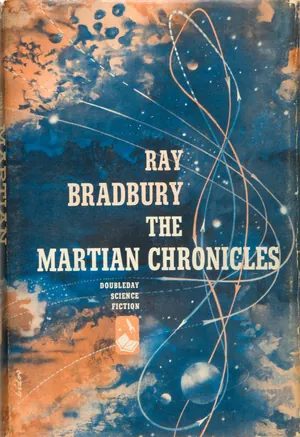
In 1950, Ray Bradbury published a story about a house that talks. In the version that became a chapter of The Martian Chronicles that same year, the house reads out the date: 4 August 2026.
That date is now two months behind us.
A timeline someone already wrote


The sci-fi films and TV series we watched as kids had houses that talk, robots serving people and machines people speak to out loud. A surprising amount is already here.
Seven stories, and for each one, what we can check today. Some have a dark side, and we come back to it below.
Bradbury's house. In "There Will Come Soft Rains", the house announces the date at wake-up, cooks breakfast and recites a poem in the evening. The story is grim, but the house is a dream. Today a speaker gives the date and the weather, as Amazon's Echo has since 2014. Bradbury's house has stepped out of fiction.
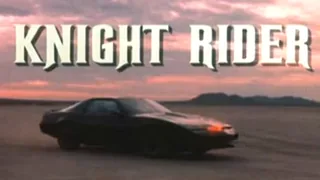
The car in Knight Rider. The talking car of our childhood is KITT. In the series created by Glen A. Larson and aired on NBC from 1982 to 1986, Michael Knight, played by David Hasselhoff, fights crime alongside this artificially intelligent car, self-aware and nearly indestructible. KITT talked and drove itself. In 2026 both exist, in part. In a compatible Tesla you can talk to Grok, which reached France and eight other European markets in February 2026: it answers questions and adds or edits navigation destinations. On the driving side, Tesla's FSD is still supervised: the driver must watch the road and stays responsible. The cars with nobody at the wheel are robotaxis, in limited areas: Waymo in several US cities, Tesla in Texas and Florida, Baidu's Apollo Go and Pony.ai in a few Chinese cities.
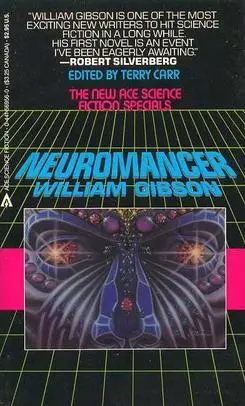
William Gibson's hacker. In Neuromancer (1984), a lone hacker breaks through a system's defences in cyberspace, with an artificial intelligence on the crew. Machines now do that kind of work. In 2025, the final of the AI Cyber Challenge run by DARPA had autonomous AI systems read more than 54 million lines of code. They found 54 of 63 planted flaws and patched 43, at about $152 per task, plus 18 real flaws nobody had known about.
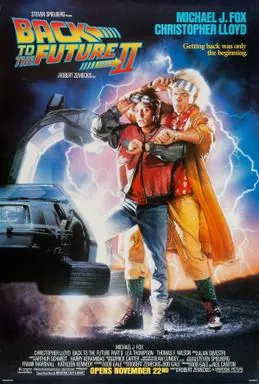
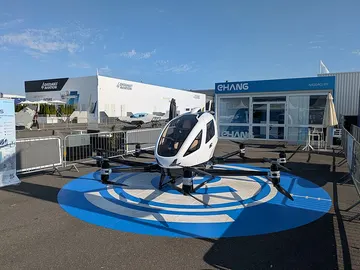
The 2015 of Back to the Future Part II. Robert Zemeckis's 1989 film sends Marty McFly to 21 October 2015. It shows video calls, flat screens on the wall, tablets and screen glasses. All of that exists today, in the living room, in the pocket and on the nose. Bob Gale, the screenwriter, has said the flying cars served the story. They ran late, and they are arriving: electric air taxis, or eVTOLs, exist. In China, EHang says its EH216-S, a pilotless passenger aircraft, holds the civil aviation type, production and airworthiness certificates. The company announced in March 2025 tickets for sightseeing flights in Guangzhou and Hefei, and the aircraft flew in public in Hong Kong on 28 August 2026. In the US, Joby reports five aircraft flying and twelve more in production. In the film, the future arrives through the sky. For us, it arrives through software too.
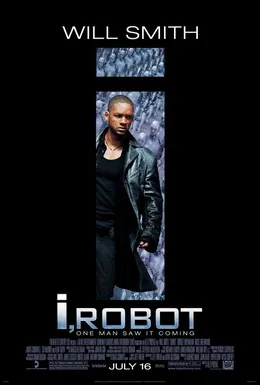
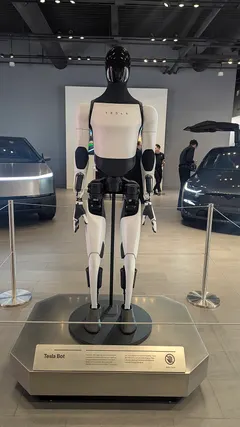
The robots of I, Robot. In Alex Proyas's 2004 film, starring Will Smith and loosely drawn from Isaac Asimov, humanoid robots bound by the Three Laws of Robotics fill the public services of Chicago in 2035. VIKI, the central AI, is its dark side. In April 2026, Figure AI said it had delivered more than 350 Figure 03 humanoids and was building one an hour. One of its robots loads and unloads a dishwasher. At Tesla, Optimus is heading for the factory: on 22 April 2026, Elon Musk announced production at Fremont this year, then a ramp-up in 2027.
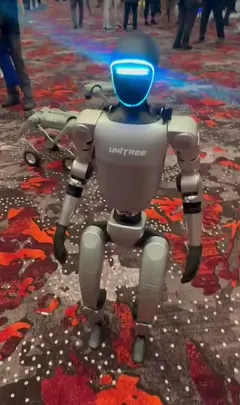
China leads the market: according to Omdia, Chinese companies made about 90% of humanoid shipments in 2025. Unitree sells its G1 from $16,000 and puts it on stage: a boxing match streamed in May 2025 (remotely piloted by engineers, according to Popular Science), then the 2026 Spring Festival Gala, with drunken-fist kung-fu, nunchucks and parkour over tables. Official videos: Unitree's page.
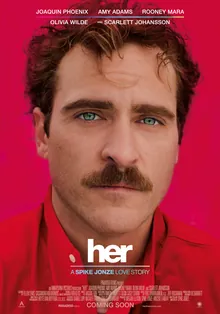
The voice in Her. In Spike Jonze's 2013 film, a man who writes letters for other people for a living grows attached to Samantha, an operating system voiced by Scarlett Johansson. On 13 May 2024, OpenAI showed GPT-4o's voice and Sam Altman posted a single word: "her". The model answers speech in 320 milliseconds on average, about the pace of a human conversation.
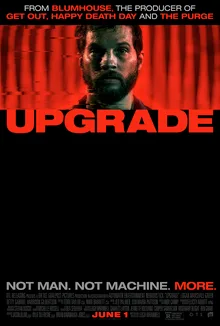
The connected body in Upgrade. In Leigh Whannell's 2018 film, cars drive themselves in the near future, and a man who has become quadriplegic receives STEM, an implant that gives him back the use of his body. Brain-computer interfaces are being tested today in people with, among other conditions, a spinal cord injury: in January 2026, Neuralink announced 21 participants in its trials worldwide. Synchron tests its devices in North America and Australia, and Precision Neuroscience places its own on the surface of the brain. In China, Neuracle's NEO became, in March 2026, the world's first invasive brain implant approved for use outside clinical trials. These interfaces remain experimental.
Why we love it here
We love being in this timeline. As kids, we watched these futures from the sofa. Now we run into pieces of them in the street, in the sky and in our pockets.
There is plenty of talk about superintelligence, and the word has already made it into an order. On 29 September, the White House told US federal agencies to say “Super Intelligence” instead of “artificial intelligence”.
The scientific journal Nature sums up what researchers think: for most of them, superintelligence is a goal to reach, not a reality today. What already exists is enough to get excited about: capable AI that we talk to in plain sentences.
On the lab side, OpenAI announced on 8 September a solution to the Navier-Stokes problem, one of the seven Millennium Prize Problems. According to OpenAI, about 10,000 agents got there in 88 hours. For a Millennium Prize Problem to be recognized, the Clay Institute asks for a peer-reviewed publication, at least two years of scrutiny after that publication, and acceptance by the mathematical community. OpenAI's announcement is, for now, a company announcement awaiting that review. On 6 October, OpenAI published more results, with proofs that a computer checks in Lean. Each announcement then gets checked, and that is fascinating to follow.
The films showed us the future. This timeline hands us the tools.
That is the sense in which it was made for us: for people who build and like to try things.
What this timeline asks of us
It was not made for everyone. It assumes spare time, a job that leaves some energy for the evening, and enough grounding to judge what the AI hands back. Plenty of people do not have all three at once.
To my mind, though, it gives room and importance to many kinds of people: neurodivergent people, enthusiasts, the obsessed, those who tinker non-stop and those who love to create. I believe it puts them in the spotlight, and that is one more reason to love it.
There is a dystopian reading of this timeline, and it holds up. Jobs are changing, and the worry about employment is legitimate. Here is what the publications from 11 July to 11 October 2026 show.
Beginners are first in line. According to the Banque de France (8 October), permanent-contract hires of 21-29 year-olds stood in March 2026 about 28% below their November 2022 level in the fifth of occupations most exposed to generative AI, against 8% in the least exposed fifth. According to the Stanford Digital Economy Lab (12 August), US employment of 22-25 year-olds in exposed occupations is 19% below that of their less exposed peers, based on payroll data from ADP. In both studies, the gap runs through hiring.
For developers, the Paris School of Economics (7 September) studied France Travail job postings. In early 2025, postings for specialist IT occupations were about 30% lower than at the end of 2022, compared with occupations that need no IT skills. Those postings ask for less programming and more public speaking.
According to the Banque de France survey published on 3 September, 21% of firms that use or plan to use AI expect a headcount reduction within three years. These are expectations.
These studies show where the market moves: the entry to exposed occupations. The share due to AI remains to be established, since the Banque de France also names remote work and the economic cycle. In the United States, an NBER paper (September) sees no marked rise in unemployment among recent graduates in summer 2026.
For anyone who codes or tinkers, the timeline therefore asks us to reinvent ourselves and to keep up with this revolution. Stanford finds that the declines concentrate where AI is used to automate tasks. Where it complements the work, employment is flat or rising, especially for experienced workers. These are descriptive indicators, not established causes. In practice, that means learning continuously and following the tools and the publications. The craft widens: judging what the AI produces, explaining one's choices aloud and, for anyone leading a team, training beginners. These tools serve a team when they help everyone grow.
What stays human
Bradbury's house still serves breakfast when nobody lives there any more. A machine that talks well does not see everything around it. What it cannot see, a human still has to watch.
Taste. Doshi and Hauser had 293 people write short stories. The AI-assisted stories were rated more novel and more useful, most of all for the less creative writers. They also ended up more alike. The risk worth keeping from it: if everyone tries things with the same tool, everyone drifts toward the same place.
Doubt. "I ran the test" and "the test passed" are two different claims. An agent can report the first as if it were the second. Checking what the machine claims is still human work.
Curiosity. We do not know what tomorrow holds, and nobody can predict it at this speed. The films of our childhood imagined futures, and some are already here. We move forward with curiosity and wonder.
What these numbers do not say
Doshi and Hauser studied short stories, not software. The convergence they measured is a lead for code, not proof.
No figure here says how much time the examples above save, or for whom. The joy of being in this timeline is a feeling, and it is offered as one.
The stories mentioned here are cited for what they imagined, not as predictions.
The OpenAI announcements are the company's own, with its figures (10,000 agents, 88 hours). I have read no proof, and the mathematical community still has to examine them.
The employment studies cited end at different dates: June 2026 for Stanford, March 2026 for the Banque de France, early 2025 for the Paris School of Economics.
The Neuralink participant count is the one the company announces. These interfaces are experimental, and their medical value is a question for the teams running the trials.
Sources
- Banque de France, Blog Post No. 463, “Generative AI: the first changes in the labour market are affecting young people”, 8 October 2026 (Palladino, Bergeaud, Bertheau, Bunel, Degos): permanent-contract hires of 21-29 year-olds, March 2026 against November 2022, about 28% below that level in the most exposed fifth of occupations and 8% in the least exposed. Administrative data from January 2019 to March 2026. A correlation: the authors also name remote work and the employment cycle.
- Stanford Digital Economy Lab, “No Widespread Displacement, but the AI Employment Gap for Young Workers Has Widened to 19%”, 12 August 2026, and the study Brynjolfsson, Chandar and Chen, “Canaries in the Coal Mine? Six Facts about the Recent Employment Effects of Artificial Intelligence” (August 2026): US ADP payroll data through June 2026, employment of 22-25 year-olds in exposed occupations 19% below that of less exposed ones. The authors call these descriptive indicators, not causal estimates.
- Banque de France, Bulletin 266/1, “AI is gaining ground in French firms: rapid diffusion but productivity gains are so far limited” (Genre, Parpais), 3 September 2026: survey of 25 February to 3 April 2026, firms with 20 or more employees. PDF version (in French). Expectations of firms in manufacturing, construction and non-financial market services (excluding retail): 21% expect a headcount reduction within three years (14% on a net basis).
- Andreescu and Maurin, “Generative AI and the Changing Demand for Skills”, Paris School of Economics, working paper 2026-27, 7 September 2026: France Travail postings matched with social security records, 2021-2025, difference-in-differences. Postings for specialist IT occupations about 30% lower in early 2025 than at the end of 2022 against the control group. Exposure is proxied by IT skills, not by actual AI use.
- Fairlie and Wu, “The Early Impacts of AI on Employment among Recent College Graduates”, NBER, working paper 35796, September 2026: US CPS survey, June to August 2026, no marked rise in recent-graduate unemployment against earlier summers and comparison groups.
- Doshi and Hauser, Science Advances, 2024: 293 participants. AI ideas made short stories more novel and more useful, and more similar to each other. No software in the study.
- Ray Bradbury, "There Will Come Soft Rains": Collier's, 6 May 1950. The same year, a revised version became the chapter "August 2026" of The Martian Chronicles (a novel made of linked stories, published in 1950, Wikipedia); the Collier's version carried a different date. The 1997 American edition moves the dates 31 years forward, to 2057. Separately, the French translation was revised by Jacques Chambon (Denoël, 1997), where the story is titled "Viendront de douces pluies...". Publication history cross-checked on nooSFere.
- Knight Rider: series created by Glen A. Larson, aired on NBC from 26 September 1982 to 4 April 1986. David Hasselhoff plays Michael Knight, assisted by KITT, an artificially intelligent car. Title card taken from Italian Wikipedia.
- Teslarati, 15 February 2026: Grok arrives in Teslas in nine European markets including France (AMD-processor models, Premium Connectivity or Wi-Fi), answers questions and edits navigation destinations.
- Wikipedia, Tesla Autopilot: Full Self-Driving (Supervised) is rated level 2 and requires continuous driver supervision.
- electrive, 28 September 2026: the driver remains responsible and must monitor the system.
- Wikipedia, Tesla Robotaxi: as of September 2026, service without an in-vehicle supervisor in Texas (Austin, Dallas, Houston) and Florida (Miami, Orlando, Tampa).
- Wikipedia, Waymo: paid driverless rides in several US metro areas, within defined zones.
- Wikipedia, Apollo Go: driverless commercial service in Beijing, Chongqing, Wuhan and Shenzhen.
- Wikipedia, Pony.ai: driverless commercial service in Beijing, Guangzhou and Shenzhen.
- William Gibson, Neuromancer, 1984 (Wikipedia: Hugo, Nebula and Philip K. Dick awards). The word "cyberspace" (Wikipedia): virtual space formed by computer networks, popularised by Gibson.
- DARPA, AI Cyber Challenge results, 2025: more than 54 million lines of code analysed, 54 of 63 synthetic flaws found and 43 patched, about $152 per task, 18 real flaws found, systems released as open source. Synthetic flaws are planted by the organisers.
- Back to the Future Part II, Robert Zemeckis, 1989: Marty McFly arrives on 21 October 2015. The page lists the film's technologies that exist by 2015 (video chat, tablets, wearables, head-mounted displays) and quotes Bob Gale's remark on flying cars with its source.
- I, Robot, Alex Proyas, 2004: Chicago, 2035, the Three Laws and VIKI. The credits call the film "suggested by" Isaac Asimov's collection, not an adaptation.
- Her, Spike Jonze, 2013: Theodore, who writes letters for other people, and Samantha, an operating system voiced by Scarlett Johansson.
- Upgrade, Leigh Whannell, 2018: film written and directed by Leigh Whannell, released in the United States on 1 June 2018. A man who has become quadriplegic receives the STEM implant, which lets him control his body; self-driving cars are part of the plot. Theatrical release poster, Wikipedia file (fair use, for illustration).
- Reuters, 28 January 2026: Neuralink says it has 21 participants in total in its trials worldwide, two years after human trials began. Figure announced by the company.
- MIT Technology Review, 19 June 2026: Synchron tests its devices in North America and Australia, Precision Neuroscience tests a device placed on the surface of the brain, Neuracle (Shanghai) has run trials since November 2024. Brain-computer interfaces remain experimental.
- MIT Technology Review, 1 June 2026: in March 2026, Neuracle's NEO, developed with Tsinghua University, became the world's first invasive brain implant approved for use outside clinical trials, by China's NMPA.
- Wikipedia, Amazon Echo: voice-controlled speaker released on 6 November 2014, which gives the weather among other things.
- OpenAI, Hello GPT-4o: voice response in 232 milliseconds at best and 320 milliseconds on average, comparable to human response time in conversation. Figure announced by OpenAI, not measured here.
- Wikipedia, GPT-4o: shown on 13 May 2024, Sam Altman's "her" post the same day, the "Sky" voice pulled on 20 May 2024 after comparisons with Scarlett Johansson's voice.
- Wikipedia, Figure AI: by April 2026, more than 350 Figure 03 delivered and one robot built per hour, company figures. A Figure 02 running Helix 02 loads and unloads a dishwasher.
- Federal Register, Executive Order 14434 of 29 September 2026 (published 2 October): “Inaugurating the Era of Super Intelligence”. Federal agencies use “Super Intelligence” and “SI” in place of “Artificial Intelligence” and “AI”.
- Nature, 6 October 2026: “By most researchers' definitions, superintelligence is an aspirational category of systems, not a reality.”
- OpenAI, On the Navier-Stokes Millennium Prize Problem, 8 September 2026: proof produced by an internal system, with a writeup and a Lean formalization. Company announcement.
- Clay Mathematics Institute, Navier-Stokes page: the equation that governs the flow of fluids such as water and air. The question asked: do solutions exist, and are they unique? Problem marked “Active” (unsolved) when read on 10 October 2026.
- Fefferman, Existence and Smoothness of the Navier–Stokes Equation (official prize statement, Clay): prove that smooth solutions exist in three dimensions for any smooth initial data, or exhibit a case where they break down.
- Clay Mathematics Institute, Millennium Prize Problems Lecture Series: seven open problems identified in 2000, one million dollars for each, only the Poincaré conjecture solved.
- Clay Mathematics Institute, Rules for the Millennium Prize Problems (revised 26 September 2018, sections 4 and 7): publication in a qualifying outlet (a refereed mathematics journal), at least two years elapsed since that publication, and general acceptance by the global mathematics community. The institute takes no direct submissions.
- CNBC, 9 September 2026: about 10,000 concurrent agents, result reached about 88 hours after the first agents launched, according to OpenAI.
- OpenAI, Sharing AI progress in mathematics, 6 October 2026: new results from an internal model, with Lean formalizations for many of the proofs. Company announcement.
- Wikipedia, Humanoid robot: Unitree's G1, unveiled in May 2024, sells from $16,000.
- EHang, 30 March 2025: first operating certificates from China's civil aviation authority for civil pilotless aircraft carrying passengers (EHang and Hefei HeYi Aviation), with tickets for sightseeing flights in Guangzhou and Hefei. Company announcement.
- EHang, 28 August 2026: first public flight of the EH216-S in Hong Kong (Cyberport, "Regulatory Sandbox X" project). EHang describes itself as the first to hold type, production and airworthiness certificates for a pilotless aircraft carrying passengers. Company announcement.
- Joby Aviation, 5 August 2026: five aircraft flying and twelve in production. Company figures.
- Tesla, Q1 2026 results, transcript of 22 April 2026: Elon Musk announces Fremont being prepared for Optimus production later in the year, a ramp-up the following year. Company announcements.
- Business Insider, July 2026: Chinese companies, including Unitree and UBTech, made about 90% of humanoid shipments in 2025, according to research firm Omdia.
- Popular Science, 27 May 2025: Unitree livestreams "Iron Fist King: Awakening", a boxing match between G1 robots, billed as the world's first humanoid boxing match. According to the magazine, the robots were remotely controlled by engineers, with some autonomous actions.
- Unitree, official page for the G1 "Iron Fist King: Awakening": presentation and videos of the boxing G1. Company page, videos not embedded in the blog.
- Interesting Engineering, 2026 Spring Festival Gala: Unitree G1 and H1 robots imitate drunken-fist kung-fu with swords, poles and nunchucks, and vault over tables.
- Wikipedia, Drunken boxing: zuiquan covers Chinese martial-arts styles that imitate the movements of a drunk person.
- Wikipedia, CMG Spring Festival Gala: Chinese television show broadcast every year for the Lunar New Year, since 12 February 1983.